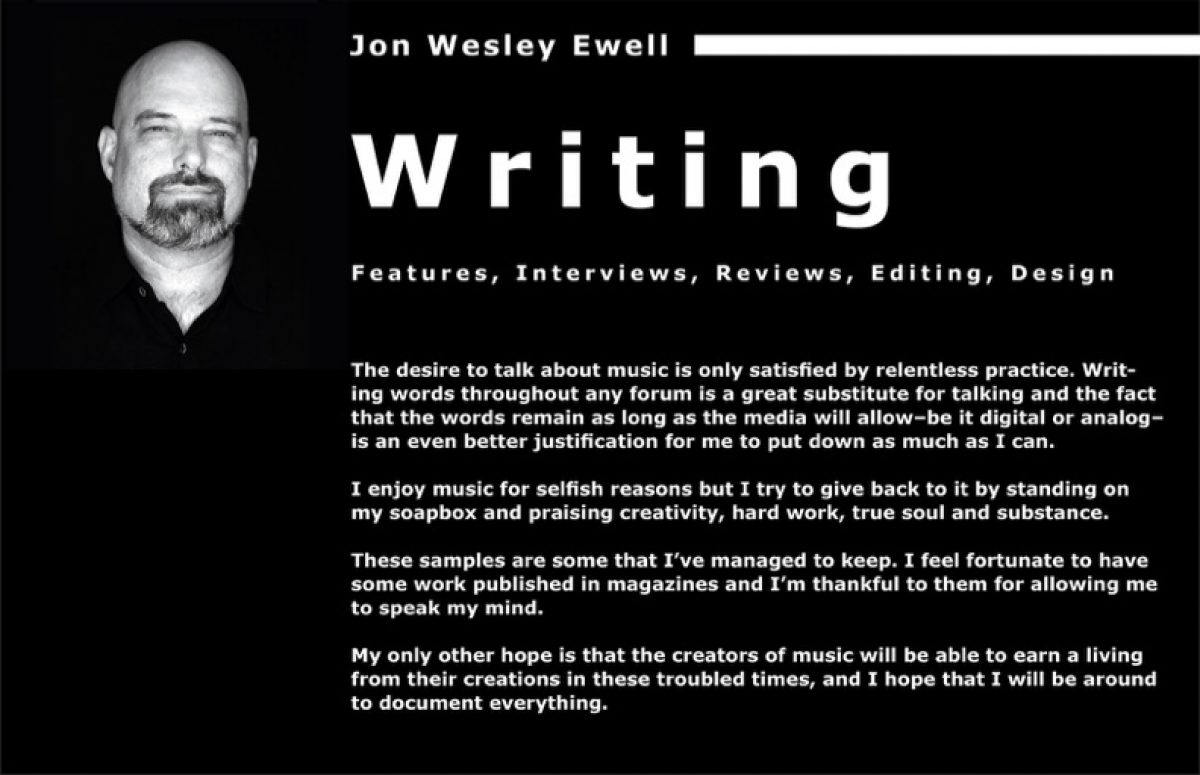
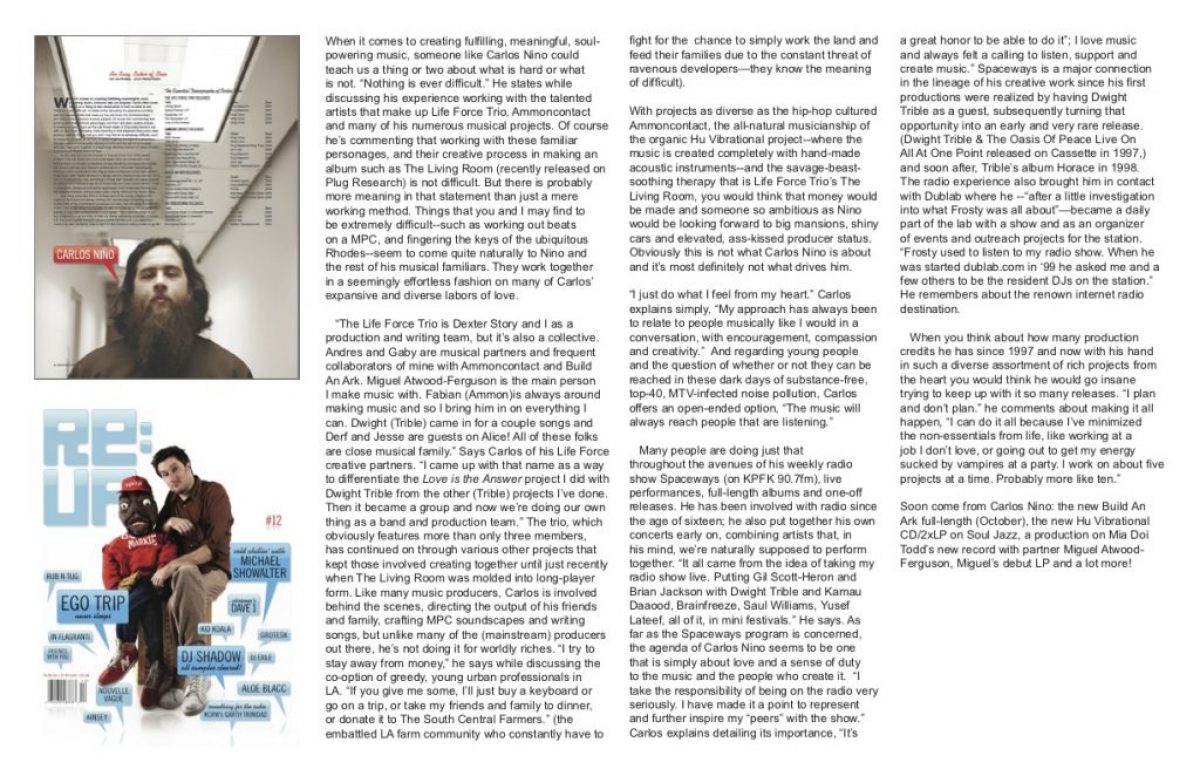
I have been a music writer for many years. Most recently I was a writer for the Live Nation Property Insomniac which holds some of the largest electronic music festivals in the country. Before that, I was the music editor for BPM Magazine/DJMixed.com, a writer for local San Diego club mag Where@ in the late 90s, and I was a feature writer and music reviewer for RE:UP magazine in the early 2000s. Re-Up Magazine Issue 12 Digital Booklet (feature on Carlos Niño on page 30 and a music review for Zero DB on page 90.)
Writing portfolio: (view or download PDF)
Read some text feature samples at the top and music reviews down below.
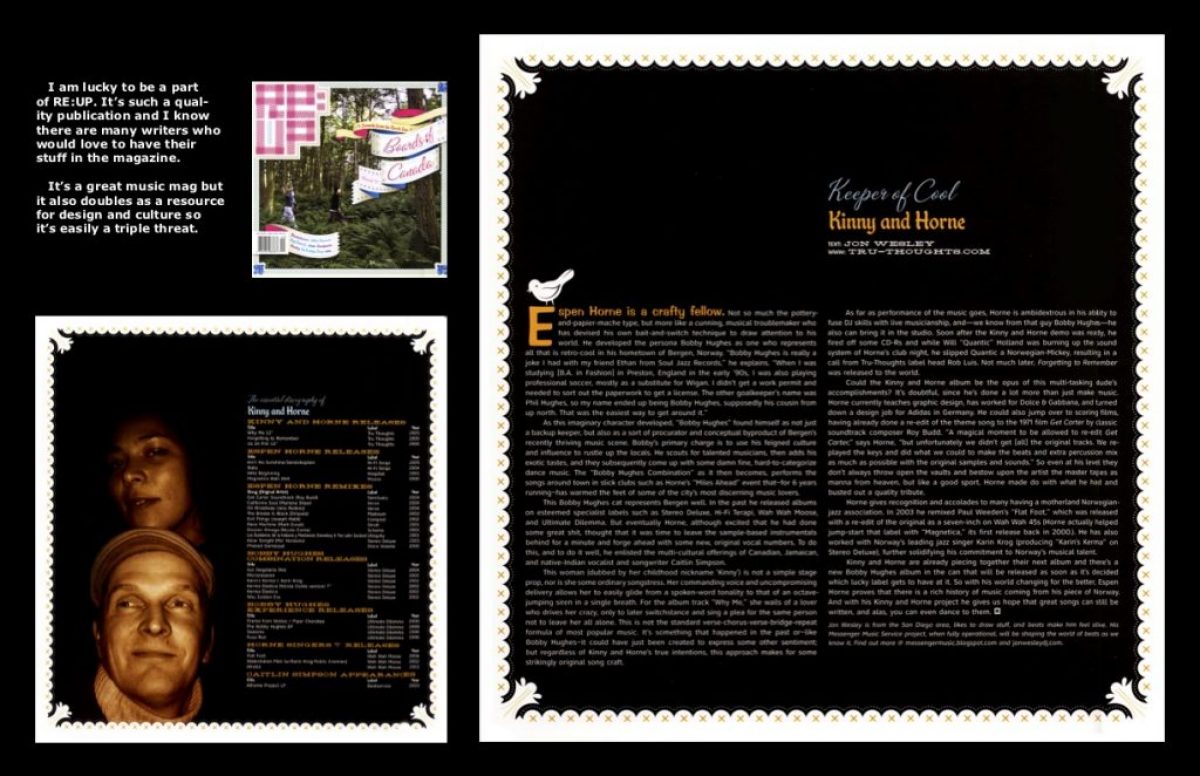
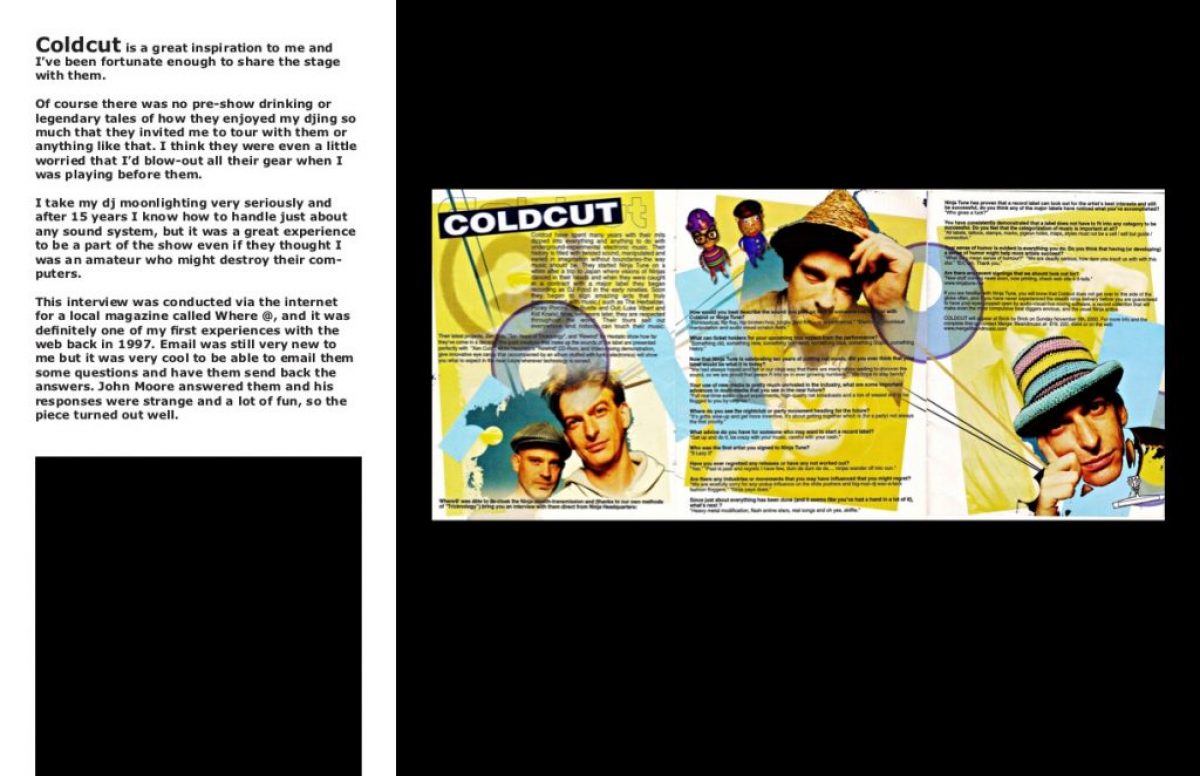
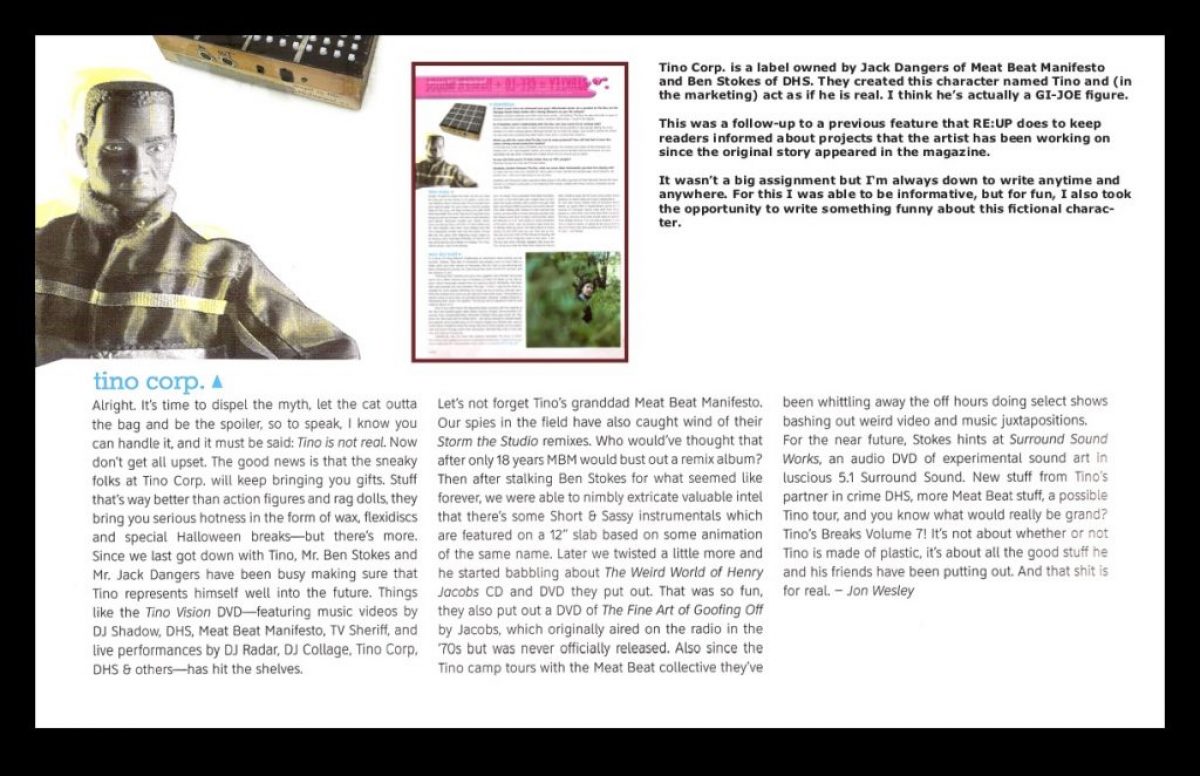
Features
Click tabs to view text
Does Your Mama Know for Insomniac
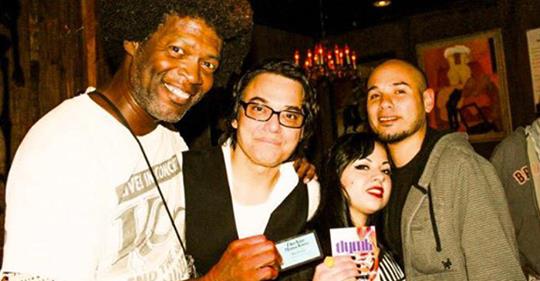
L.A. Nightlife Gone: Does Your Mama Know? 1992–2003
This is a feature I wrote about the legendary LA after-hours club Does Your Mama Know. Read all about how Missy Eliott grabbed my crotch in the booth while I was playing there. There are also stories of Grace Jones and the scandalous local LA news trying to get in.
-
This is my review for Richard Dorfmeister VS. Madrid de los Austrias Grand Slam G-Stone Recordings for RE:UP magazine. When I was a music editor for BPM Magazine, we would get reviews from our writers (mostly djs doing it for little pay or free records) and they would try to describe every little sound in the song. It was weird and a little annoying. I always liked to talk about music in a funny way that I hope would make people curious enough to check out the music. Some people might be annoyed by my style but it works for me.
“Grand Slam is a fine collection of remixes by Dorfmeister and MDLA. Now when I say “fine” I mean something like one of those tired adjectives we use all the time
like: “sick,” “dope,” “fabulous” —don’t act like you never bust out a “fabulous” every now and then—”awesome”…you get the idea. Anyway I’m back to the word “fine” because it works well in describing
the smooth, funky sounds found on this release. I’m not super crazy about Zero 7 but these guys most definitely turned out their remix of “In the Waiting Line”; they also crushed Willie Bobo’s “Spanish Grease” with a fat, double bassline and its ghostly Latin sounds lurking in the background. Grand Slam is pretty much a house music party on the whole disc but it’s an excellent quality of house that will sound great to people who think they don’t like the very popular genre. There are some rough and tough jams a little
later on too. Like Koop’s” Relaxin’ at Club F****n.” It’s obvious what that spells but the funky bass action just might get you laid if you play it for the right person. I never heard the original version of Pressure Drop’s “Back 2 Back” (and I love me some Pressure Drop) but Dorfmeister & MDLA make them sound like freaking champions. Oh it gets better. They even have some original smokers on here too. “Make Dis Real” is so damn hot with its funky breakbeat and slick, soul-man vocal, it will get rocked again and again by pro DJs and iPod-button-pushers alike. Now if you like what I’m saying
you should definitely buy this disc, or the download version, or even the wax if you can find some. Just don’t steal it because people who make music this good deserve to get rich. “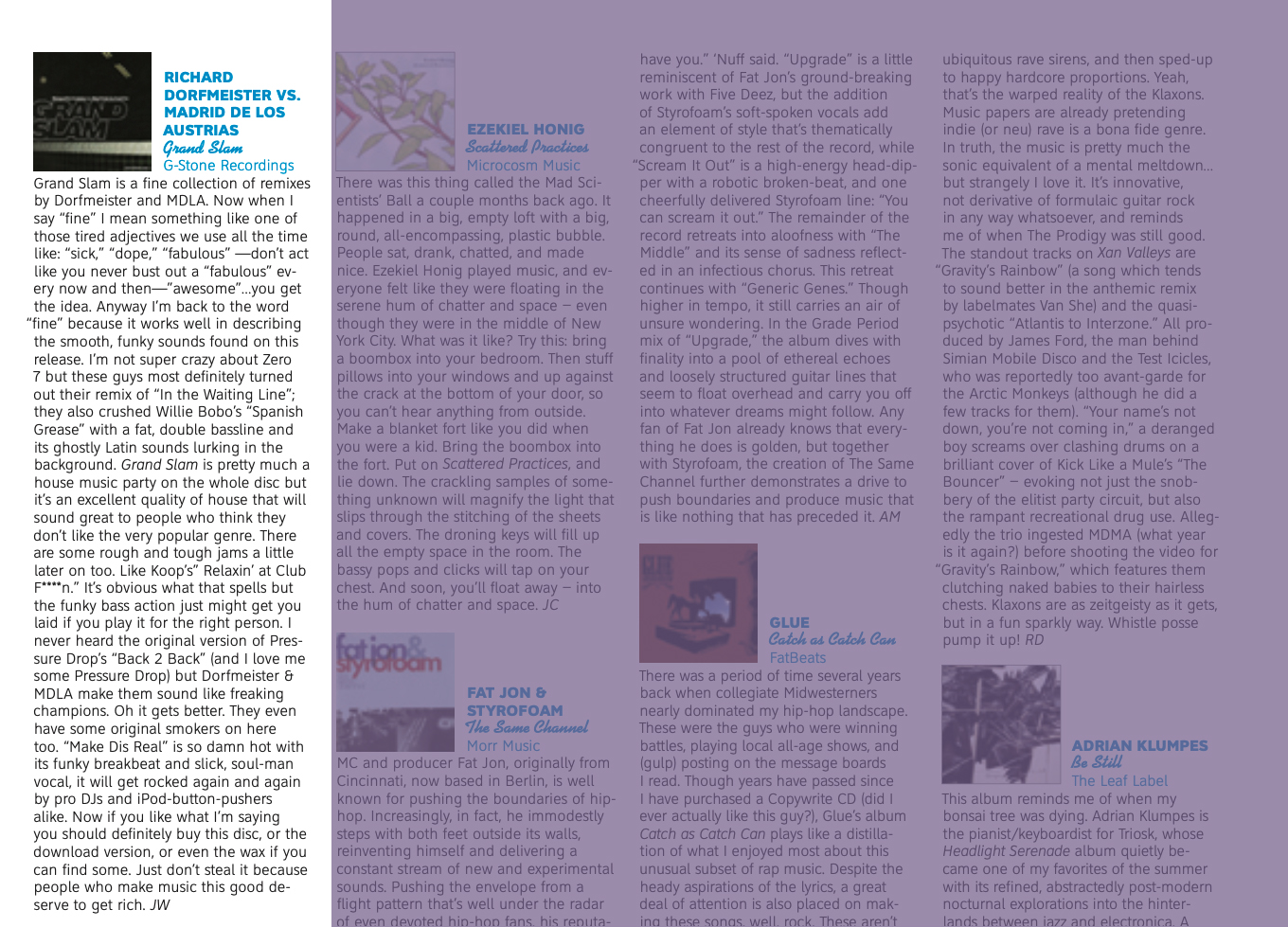
-
When it comes to creating fulfilling, meaningful, soul-powering music, someone like Carlos Niño could teach us a thing or two about what is hard or what is not. “Nothing is ever difficult.” He states while discussing his experience working with the talented artists that make up Life Force Trio, Ammoncontact and many of his numerous musical projects. Of course he’s commenting that working with these familiar personages, and their creative process in making an album such as The Living Room (recently released on Plug Research) is not difficult. But there is probably more meaning in that statement than just a mere working method. Things that you and I may find to be extremely difficult–such as working out beats on a MPC, and fingering the keys of the ubiquitous Rhodes–seem to come quite naturally to Niño and the rest of his musical familiars. They work together in a seemingly effortless fashion on many of Carlos’ expansive and diverse labors of love.
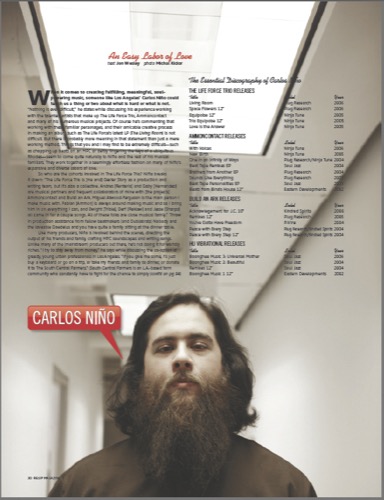
“The Life Force Trio is Dexter Story and I as a production and writing team, but it’s also a collective. Andres and Gaby are musical partners and frequent collaborators of mine with Ammoncontact and Build An Ark. Miguel Atwood-Ferguson is the main person I make music with. Fabian (Ammon) is always around making music and so I bring him in on everything I can. Dwight (Trible) came in for a couple songs and Derf and Jesse are guests on Alice! All of these folks are close musical family.” Says Carlos of his Life Force creative partners. “I came up with that name as a way to differentiate the Love is the Answer project I did with Dwight Trible from the other (Trible) projects I’ve done. Then it became a group and now we’re doing our own thing as a band and production team.” The trio, which obviously features more than only three members, has continued on through various other projects that kept those involved creating together until just recently when The Living Room was molded into long-player form. Like many music producers, Carlos is involved behind the scenes, directing the output of his friends and family, crafting MPC soundscapes and writing songs, but unlike many of the (mainstream) producers out there, he’s not doing it for worldly riches. “I try to stay away from money,” he says while discussing the co-option of greedy, young urban professionals in LA. “If you give me some, I’ll just buy a keyboard or go on a trip, or take my friends and family to dinner, or donate it to The South Central Farmers.” (the embattled LA farm community who constantly have to fight for the chance to simply work the land and feed their families due to the constant threat of ravenous developers—they know the meaning of difficult).
With projects as diverse as the hip-hop cultured Ammoncontact, the all-natural musicianship of the organic Hu Vibrational project–where the music is created completely with hand-made acoustic instruments–and the savage-beast-soothing therapy that is Life Force Trio’s The Living Room, you would think that money would be made and someone so ambitious as Nino would be looking forward to big mansions, shiny cars and elevated, ass-kissed producer status. Obviously this is not what Carlos Niño is about and it’s most definitely not what drives him.
“I just do what I feel from my heart.” Carlos explains simply, “My approach has always been to relate to people musically like I would in a conversation, with encouragement, compassion and creativity.” And regarding young people and the question of whether or not they can be reached in these dark days of substance-free, top-40, MTV-infected noise pollution, Carlos offers an open-ended option, “The music will always reach people that are listening.”
Many people are doing just that throughout the avenues of his weekly radio show Spaceways (on KPFK 90.7fm), live performances, full-length albums and one-off releases. He has been involved with radio since the age of sixteen; he also put together his own concerts early on, combining artists that, in his mind, we’re naturally supposed to perform together. “It all came from the idea of taking my radio show live. Putting Gil Scott-Heron and Brian Jackson with Dwight Trible and Kamau Daaood, Brainfreeze, Saul Williams, Yusef Lateef, all of it, in mini festivals.” He says. As far as the Spaceways program is concerned, the agenda of Carlos Niño seems to be one that is simply about love and a sense of duty to the music and the people who create it. “I take the responsibility of being on the radio very seriously. I have made it a point to represent and further inspire my “peers” with the show.” Carlos explains, detailing its importance, “It’s a great honor to be able to do it. I love music and always felt a calling to listen, support and create music.”
Spaceways is a major connection in the lineage of his creative work since his past productions were realized by having Dwight Trible as a guest, subsequently turning that opportunity into an early and very rare release. (Dwight Trible & The Oasis Of Peace Live On All At One Point released on Cassette in 1997,) and soon after, Trible’s album Horace in 1998. The radio experience also brought him in contact with Dublab where he – “after a little investigation into what Frosty was all about” – became a daily part of the lab with a show and as an organizer of events and outreach projects for the station. “Frosty used to listen to my radio show.”He remembers about the renown internet radio destination. “When he was started dublab.com in ‘99 he asked me and a few others to be the resident DJs on the station.”
When you think about how many production credits he has since 1997 and now with his hand in such a diverse assortment of rich projects from the heart you would think he would go insane trying to keep up with it so many releases. “I plan and don’t plan.” he comments about making it all happen, “I can do it all because I’ve minimized the non-essentials from life, like working at a job I don’t love, or going out to get my energy sucked by vampires at a party. I work on about ve projects at a time. Probably more like ten.”
Soon come from Carlos Niño: the new Build An Ark full-length (October), the new Hu Vibrational CD/2xLP on Soul Jazz, a production on Mia Doi Todd’s new record with partner Miguel Atwood- Ferguson, Miguel’s debut LP and a lot more!
-
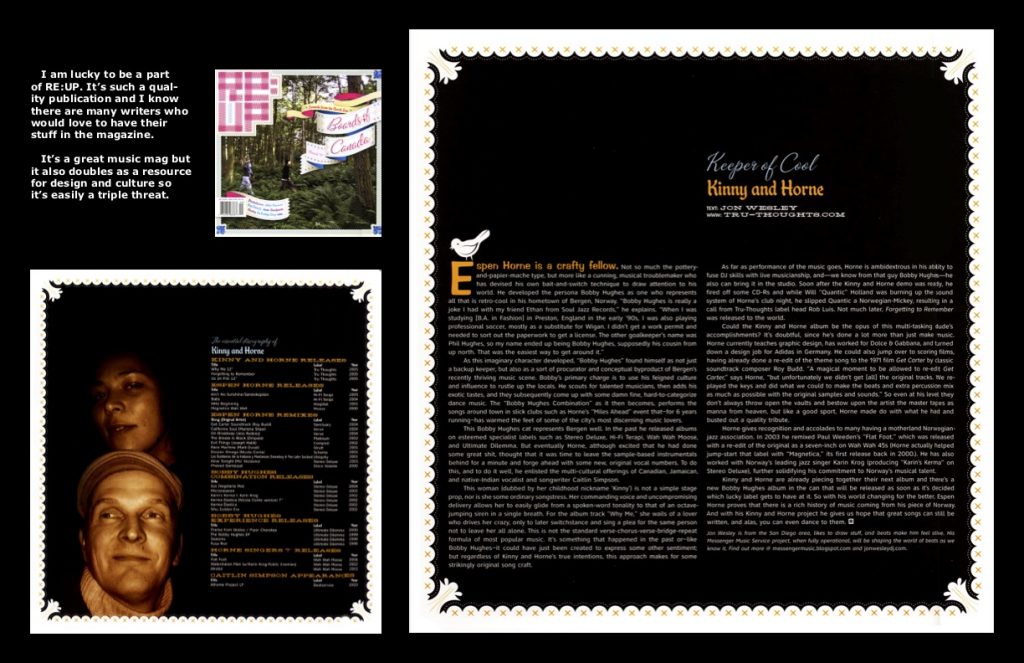
I don’t have the text for this one so the PDF will have to do.
(click to read in browser or download for better viewing since you may have to zoom in.)
-
Mark Farina recently played at EDC Las Vegas for the first time in 2016.

“My experience playing at EDC Vegas this year was great. I played the earlier events in LA but this was my first time at the Vegas EDC. I played the closing set on Monday morning (at the Upside Down House stage) after Juan Atkins who I had not shared the stage with for some time, so that was exciting, plus it was really nice to see some of the house heads come out.”
Now he’s preparing for the new release of his Mushroom Jazz 8 mix series (out on July 22, 2016), and he is also celebrating twenty-five years of Mushroom Jazz.
Anything that lasts twenty-five years must be good right? A relationship, a band, a vehicle – or in this case a mix series – after so many years can tell its own stories, it can be a legend, it can be a legacy.
What is Mushroom Jazz 8? It is all of the above: a relationship, a band of various artists, a vehicle for discovering new music (that you may never hear without listening to the mix), a legend of past adventures told by thousands who have listened and a legacy of one of the world’s best djs.
Think about that for a minute: one of the World’s best djs. Imagine you are Mark Farina. You are really good at what you do, you are humble, and in our case, you are happy to talk about the eighth licensed mix release. This demonstrates an appreciation of an artist’s place in the musical food chain. While being at the top, he understands that his role is to bring these sounds to the world, and not just in the form of a regular compilation, but instead, mixed in a way that no one else can.
Mark describes his relationship with Mushroom jazz in a very personal manner. It is a part of him and it is an aspect of his art that continues to evolve. He created it many years ago and cultivated it from a series of mixtapes (around 20 tape releases along with another series called Downtempo Forest and its 20 or so volumes) into a high-quality, licensed release series.
Like a tree, it grew from the ground up over a period of years, with enough headroom and space for interpretation like any quality art. The listener can explicate Mushroom Jazz in his or her own way. The mix is designed to allow us to get into our own heads and experience it as our subconscious sees fit.
“I always wanted the music for Mushroom Jazz to be more organic. I knew that by combining short instrumental tracks into a stream of sound I could do what I wanted. In the past volumes, there were many songs that stood out and that people remembered. For this latest mix I wanted to present heady, thoughtful music and I wanted to stay away from a single or series of single songs, and let it become a whole.”
He plays this style of music regularly during his travels. Sometimes he is booked to play a longer set so he’ll begin with Mushroom Jazz and build up to his Chicago house sound for which he is also well known around the world. Other times he will play the House on one stage and then play Mushroom Jazz on another stage, at the same event.
“One of the benefits of doing two different genres, is that sometimes different times call for different styles.” Mark explains, “It can open up many other possibilities.”
The process for creating the mix begins with compiling a list of twenty or more tracks and then getting them cleared for licensing.
“Since many of the songs are sample-based you never know.” Farina adds, “An artist is at risk of getting in trouble for using a sample.”
“One time I think it was volume two or three, Farina remembers, a jazz guitarist was in a retail store and the Mushroom Jazz mix was playing, he noticed his work had been sampled by one of the artists on the comp and he contacted the label and wanted to be paid.” He adds, “You have to be careful to make sure everything is cleared before you begin the mix, so you don’t have to go back and remove anything.”
After the group of tracks is licensed and cleared, the mix is created and the project comes to life. Then the complete lifecycle of art-becoming-product begins. Mark and his team are very creative in financing the project. If you view Mushroom Jazz 8 on pledgemusic.com you’ll see various packages that are available to fans who donate to the cause, which helps to finance the release. There are things like vinyl test pressings, remix offers, packages containing Mark’s original photographic artwork, custom headphones, VIP passes to performances, all the way to a private dj set by Farina for a hefty but worthwhile investment. Everyone gets to contribute to the art and they get something in return, in addition to the music itself.
He sources the tracks from peers with whom he has worked in the past like Colosuss, but he also digs through the digital bins of sites like Soundcloud to discover new artists. Tracks like “Night Light” by PH-Wert and “Rain Drops” by Freddie Joachim sit perfectly in the same company as better known artists like DJ Spinna, whose song “Duke” is one of the standouts. As Mark puts it, “I was very happy to get one from Spinna on this one.”
Mushroom Jazz 8 is a perfect return to form for the series. It begins as many of his mixes do, with an intro of a sample encouraging one to “listen as well as you know how…” The Jazz flows throughout and each track is perfectly blended into a seamless sound. The bumping hip-hop beats and tempo – which are the secret ingredients to Mark’s Mushroom Jazz sound – continue throughout. You can always tell a great mix when you enjoy it so much that it ends before you are ready. Much like a great film or a great party, you want it to last but when it does end you are left completely satisfied and wanting more.
With Mushroom Jazz 8 – and the last 25 years of mixtapes and eight licensed mix projects – Mark Farina is leaving the world an amazing cultural library for both young and old to enjoy. This is the perfect first step for a young person to take into a lifelong jazz journey and it’s also a great position from which an older generation can look back and say something like, “I told you this music is amazing, and there is an almost endless amount in the world for you to enjoy throughout your life.”
-
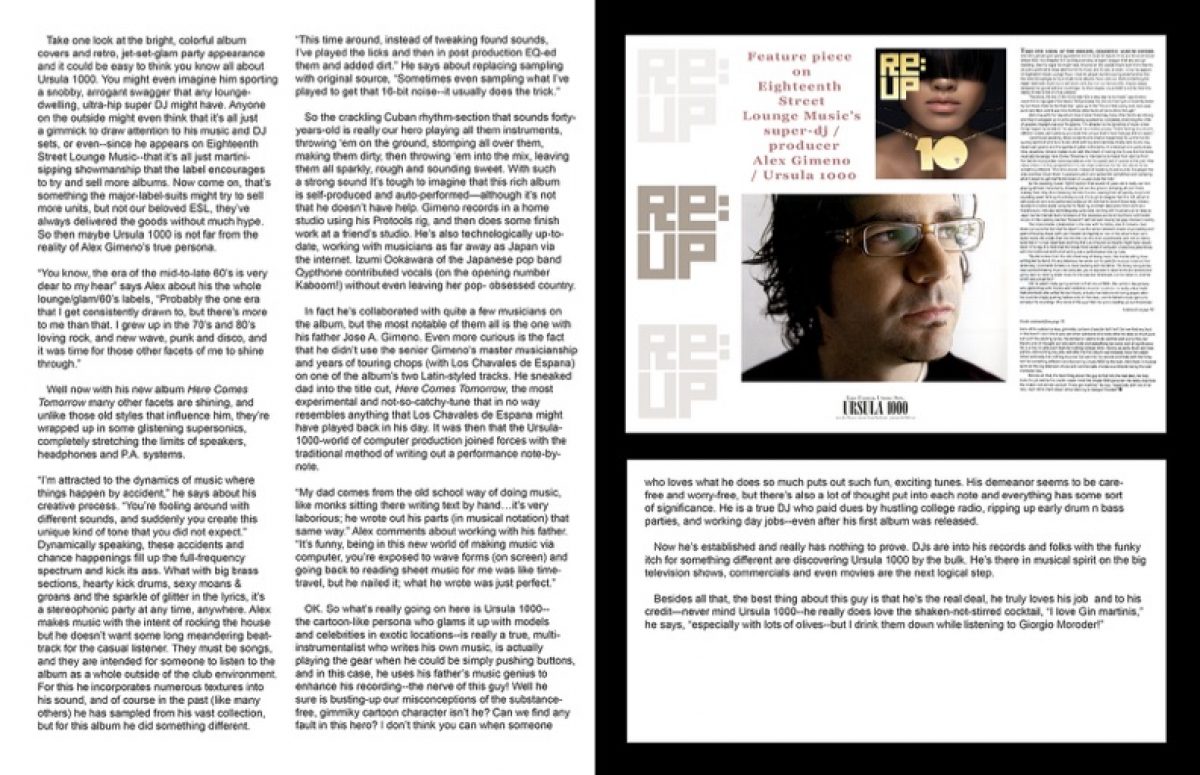
Take one look at the bright, colorful album covers and retro, jet-set-glam party appearance and it could be easy to think you know all about Ursula 1000. You might even imagine him sporting a snobby, arrogant swagger that any lounge-dwelling, ultra-hip super DJ might have. Anyone on the outside might even think that it’s all just a gimmick to draw attention to his music and DJ sets, or even – since he appears on Eighteenth Street Lounge Music – that it’s all just martini-sipping showmanship that the label encourages to try and sell more albums. Now come on, that’s something the major-label-suits might try to sell more units, but not our beloved ESL, they’ve always delivered the goods without much hype.
So then maybe Ursula 1000 is not far from the reality of Alex Gimeno’s true persona. “You know, the era of the mid-to-late 60’s is very dear to my hear” says Alex about his the whole lounge/glam/60’s labels, “Probably the one era that I get consistently drawn to, but there’s more to me than that. I grew up in the 70’s and 80’s loving rock, and new wave, punk and disco, and it was time for those other facets of me to shine
through.”Well now with his new album Here Comes Tomorrow many other facets are shining, and unlike those old styles that influence him, they’re wrapped up in some glistening supersonics, completely stretching the limits of speakers, headphones and P.A. systems.
“I’m attracted to the dynamics of music where things happen by accident,” he says about his creative process. “You’re fooling around with different sounds, and suddenly you create this unique kind of tone that you did not expect.”
Dynamically speaking, these accidents and chance happenings fill up the full-frequency spectrum and kick its ass. What with big brass sections, hearty kick drums, sexy moans & groans and the sparkle of glitter in the lyrics, it’s a stereophonic party at any time, anywhere.
Alex makes music with the intent of rocking the house but he doesn’t want some long meandering beat track for the casual listener. They must be songs, and they are intended for someone to listen to the album as a whole outside of the club environment. For this he incorporates numerous textures into his sound, and of course in the past (like many others) he has sampled from his vast collection, but for this album he did something different.
“This time around, instead of tweaking found sounds, I’ve played the licks and then in post production EQ-ed them and added dirt.” He says about replacing sampling with original source, “Sometimes even sampling what I’ve played to get that 16-bit noise–it usually does the trick.”
So the crackling Cuban rhythm-section that sounds forty-years-old is really our hero playing all them instruments, throwing ‘em on the ground, stomping all over them, making them dirty, then throwing ‘em into the mix, leaving them all sparkly, rough and sounding sweet.
With such a strong sound It’s tough to imagine that this rich album is self-produced and auto-performed—although it’s not that he doesn’t have help. Gimeno records in a home studio using his Protools rig, and then does some finish work at a friend’s studio. He’s also technologically up-to-date, working with musicians as far away as Japan via the internet. Izumi Ookawara of the Japanese pop band Qypthone contributed vocals (on the opening number Kaboom!) without even leaving her pop- obsessed country. In fact he’s collaborated with quite a few musicians on the album, but the most notable of them all is the one with his father Jose A. Gimeno. Even more curious is the fact that he didn’t use the senior Gimeno’s master musicianship and years of touring chops (with Los Chavales de Espana) on one of the album’s two Latin-styled tracks. He sneaked dad into the title cut, Here Comes Tomorrow, the most experimental and not-so-catchy-tune that in no way resembles anything that Los Chavales de Espana might have played back in his day. It was then that the Ursula1000-world of computer production joined forces with the traditional method of writing out a performance note-by-note.
“My dad comes from the old school way of doing music, like monks sitting there writing text by hand…it’s very laborious; he wrote out his parts (in musical notation) that same way.” Alex comments about working with his father. “It’s funny, being in this new world of making music via computer, you’re exposed to wave forms (on screen) and going back to reading sheet music for me was like time travel, but he nailed it; what he wrote was just perfect.”
OK. So what’s really going on here is Ursula 1000 – the cartoon-like persona who glams it up with models and celebrities in exotic locations – is really a true, multi-instrumentalist who writes his own music, is actually playing the gear when he could be simply pushing buttons, and in this case, he uses his father’s music genius to enhance his recording – the nerve of this guy! Well he sure is busting-up our misconceptions of the substance-free, gimmicky cartoon character isn’t he? Can we find any fault in this hero? I don’t think you can when someone who loves what he does so much puts out such fun, exciting tunes. His demeanor seems to be carefree and worry-free, but there’s also a lot of thought put into each note and everything has some sort of significance. He is a true DJ who paid dues by hustling college radio, ripping up early drum n bass parties, and working day jobs–even after his first album was released.
Now he’s established and really has nothing to prove. DJs are into his records and folks with the funky itch for something different are discovering Ursula 1000 by the bulk. He’s there in musical spirit on the big television shows, commercials and even movies are the next logical step.
Besides all that, the best thing about this guy is that he’s the real deal, he truly loves his job and to his credit – never mind Ursula 1000 – he really does love the shaken-not-stirred cocktail, “I love Gin martinis,”
he says, “especially with lots of olives – but I drink them down while listening to Giorgio Moroder!”
-
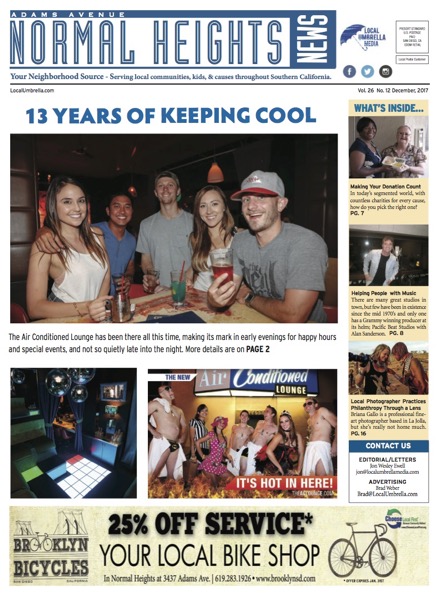
I’m the editor for a newspaper and magazine group in San Diego, CA that publishes 25 hyper local papers. This was a cover story about a small nightclub in my neighborhood.
Music Reviews
-
Here are some other music reviews for RE:UP. This magazine would let the writers be more thorough with the reviews so it was nice to be able to write more about the releases.
4Tet Everything Ecstatic Films
Presto and Richard Dorfmeister
DJ Vadim (Soundcatcher) and Love Trio
Wax Tailor, Thes One and Imperial Dub
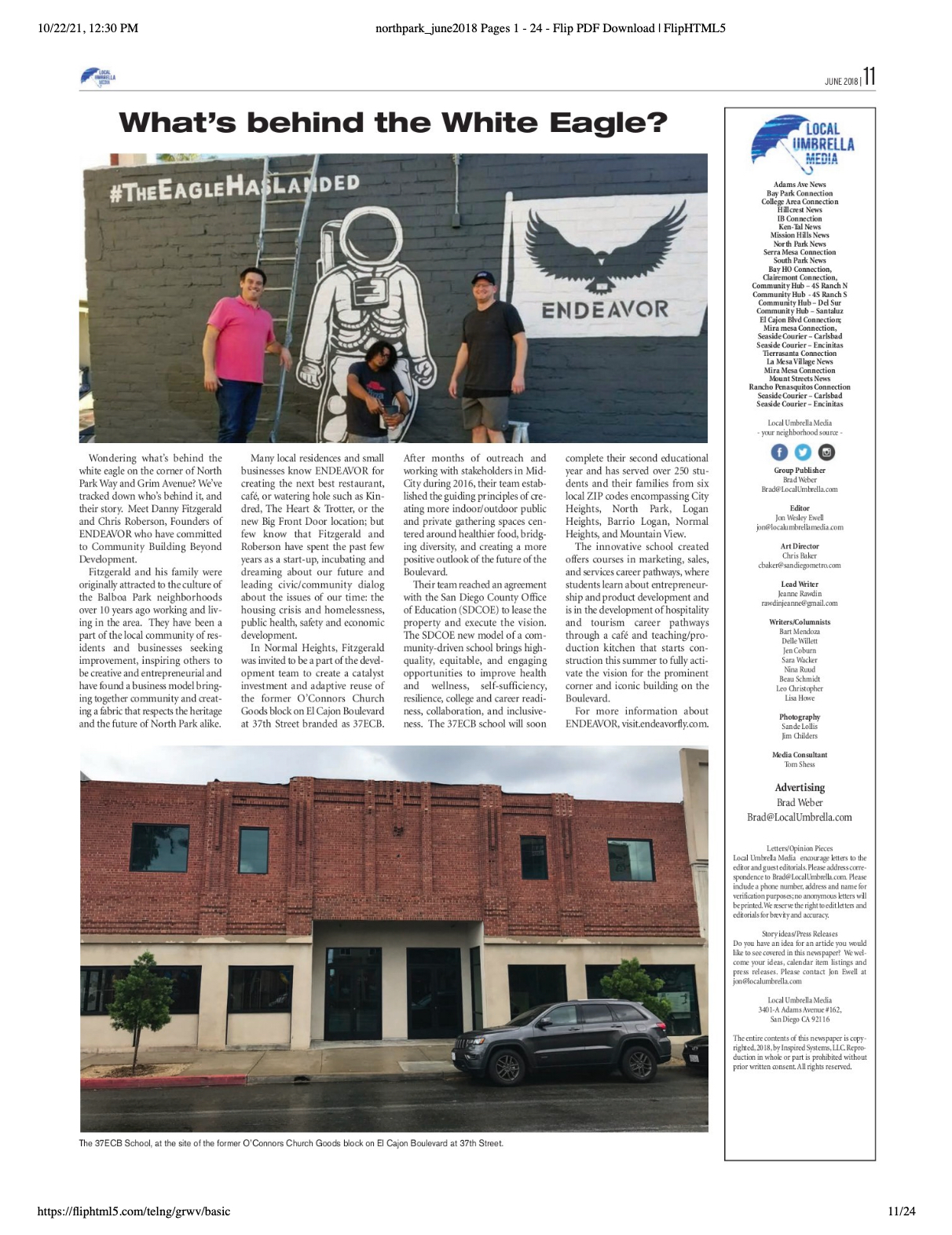
I was an editor for a community publishing company. We produced newspapers and magazines that were mailed to different zip codes in San Diego County.
Here are some samples.
-
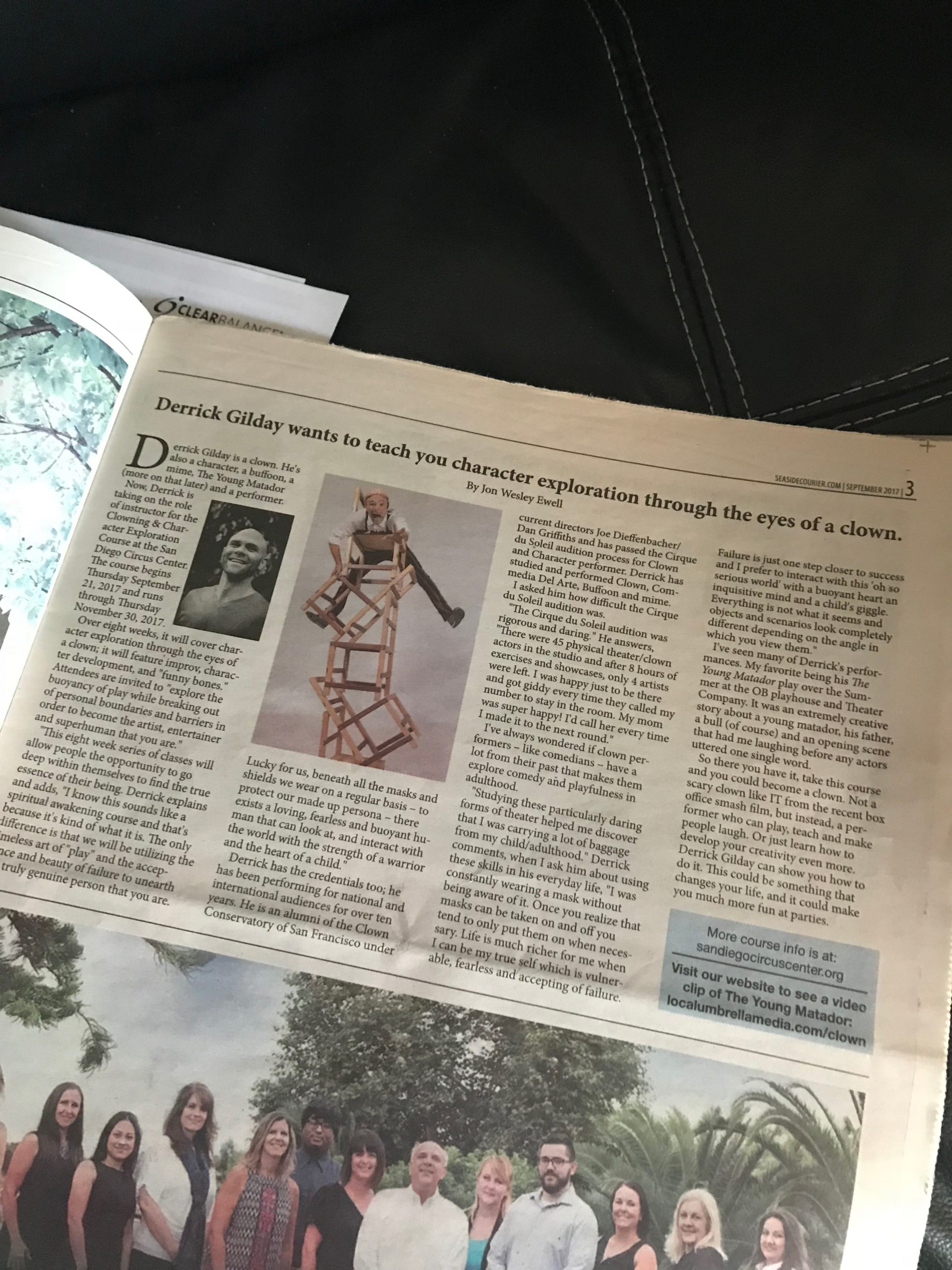
This was an article on Derrick Gilday, a talented artist and performer in San Diego.